
The Threat to LGBTQIA2+ People in Türkiye Is a Human Rights Issue

Updated: Oct 27
What does it mean to welcome the world when members of your own community are being threatened for who they are?
It is a question the international community, including the business events industry, should be asking as the situation for LGBTQIA2+ people in Türkiye deteriorates.
This is about human rights. It is about the freedom to associate, speak, organise, access information, and live without fear of persecution.
And the latest developments should concern us all.
A crackdown that cannot be ignored
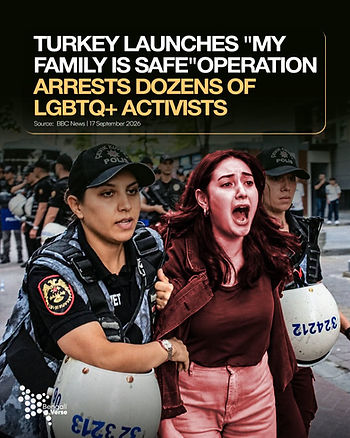
In September 2026, Turkish authorities launched a coordinated crackdown on LGBTQIA2+ communities and the organisations defending their rights. Police raids, arrests, and detentions took place across 15 provinces under an operation the authorities described as “My Family Is Safe”.
LGBTQIA2+ rights defenders, journalists and civil society organisations have been caught up in the investigations. Organisations have faced raids, websites and social media accounts have been blocked, and people have been detained pending trial.
On 13 October, United Nations human rights experts condemned the crackdown, warning that criminal, administrative and financial measures were restricting fundamental freedoms and obstructing legitimate human rights work.
These are not abstract concerns. When people face arrest for defending the rights of a marginalised community, the consequences reach far beyond those directly targeted. They create fear, discourage advocacy and make it harder for people to access support, information and solidarity.
The language used to justify these actions matters, too. Governments can invoke family values, public morality or the protection of children. Those concepts are homophobic, fake and cannot legitimately be used as a blanket justification for discrimination or the suppression of fundamental rights.
It's time we stop allowing culture and religion to be a mask for human rights abuses.
The danger of normalising exclusion
Türkiye has a long record of restrictions on LGBTQIA2+ visibility, including repeated bans on Istanbul Pride and other public gatherings. In June 2026, concerns intensified again when proposals to criminalise conduct deemed contrary to “biological sex” and public morality resurfaced.

The proposals reportedly included prison sentences of up to three years for certain broadly defined conduct or its promotion, alongside severe restrictions on gender-affirming healthcare.
These proposals must be distinguished from enacted law. Nevertheless, their reappearance, against the backdrop of the September crackdown, signals the seriousness of the threat facing LGBTQIA2+ people.
The danger is not limited to what legislation might eventually say. It also lies in the environment created when public institutions repeatedly portray a minority as a threat to society.
When a community is presented as a danger to children, family or national identity, discrimination becomes easier to excuse. Restrictions become easier to justify. And the people affected are increasingly expected to accept that their safety and dignity are negotiable.
They are not.
When the industry's own values are put to the test
In January 2026, ICCA announced that its 2028 World Congress would take place in Muscat, Oman. This follows a decision to hold the 2024 World Congress in Abu Dhabi, where LGBTQIA2+ discrimination and homophobia are active. In announcing the decision, ICCA leadership spoke about bringing diverse communities together, creating positive global impact and building shared responsibility. These are worthy ambitions. But they raise an uncomfortable question: who gets to be part of that global community, and at what cost?

Oman's laws criminalise consensual same-sex sexual activity between men. For LGBTQIA2+ professionals, that is not an abstract legal detail. It can influence whether they feel safe attending, whether they can be open about their identity and whether participating in an international industry gathering means concealing part of who they are. Like Abu Dhabi in 2024 and Dubai in 2018, the conference cannot legally advocate for LGBTQIA2+ rights in Oman in 2028, and doing so can result in criminal prosecution and imprisonment.
What is striking about ICCA's announcement is not simply the choice of destination, but what it does not address. There is no explanation of how LGBTQIA2+ member safety was considered, what human rights due diligence informed the decision, or what practical assurances are in place for members with legitimate concerns. The announcement celebrates connection, community and shared responsibility without acknowledging the unequal risks that attending may carry for some members.
This is where transparency matters. Members should not have to piece together the implications of a destination's laws, or rely on reassuring language about hospitality and inclusion without understanding how their concerns have been assessed. An international association cannot remove every risk associated with a destination. Still, it can be open about its decision-making, listen to affected members and explain what it is doing to support them. In this case, as with Abu Dhabi in 2024, ICCA failed.
The question is not whether Oman can host a successful international congress. It is whether success should be measured only by the quality of the event, the business it generates and the connections it creates, or whether we should also consider who feels able to attend, who decides they cannot, and whose experience of belonging is compromised in the process.
Why this matters to the business events industry
At New Intent, we believe business events are not separate from the political, social and human rights realities in which they take place.
Conferences, congresses, exhibitions and association meetings bring people together across borders. They create opportunities for knowledge exchange, professional development, collaboration and economic growth. But they also depend on something less tangible and just as important: people's ability to participate without fear.
What does international participation mean if an LGBTQIA2+ delegate is concerned about their safety at the destination? What does an association's devotion to inclusion mean if its members, speakers or partners could face restrictions simply for expressing who they are? And what does it mean to talk about belonging when some people's rights are treated as a political inconvenience?
These are not hypothetical questions for the global meetings industry. They are practical considerations for associations, destinations, venues, organisers, and the professionals responsible for uniting people.
Human rights should inform how we assess risk, select destinations, support delegates, interact with local partners and respond when the circumstances surrounding an event change.
This does not mean every professional or organisation must respond to every international political development in the same way. It means that decisions affecting people should be informed by evidence, an understanding of risk and an authentic commitment to their safety and dignity.
Silence is not neutral. When fundamental rights are under threat, a refusal to acknowledge the situation can leave those most affected feeling that their inclusion matters only when it is convenient.
Silence and neutrality are political stances. Let's get our heads out of the sand.
Destination decisions are never simply logistical
The business events industry often talks about destinations in terms of infrastructure, accessibility, capacity, economic impact and the quality of the delegate experience. But when LGBTQIA2+ people face increasing restrictions on their rights and freedoms, there is another question we must be prepared to ask: what does choosing a destination mean for the people we invite to gather there?
This is not an argument that every event in a country experiencing human rights abuses should automatically be cancelled. Nor is it a suggestion that withdrawing business is always the best way to support a marginalised community.
It is, however, an argument for responsible engagement.
Associations, destinations, venues and event organisers should consider the legal environment, assess the risks to LGBTQIA2+ delegates, understand the consequences for local communities and establish appropriate safeguards before making decisions. Where it is safe and appropriate, they should listen to local LGBTQIA2+ organisations rather than assume what support is needed.
A destination's ability to host an international conference is not, in itself, evidence that every delegate can participate safely and equally.
We have to move beyond asking whether a destination can accommodate an event and start asking whether attendees can participate with dignity, safety and freedom.
In some cases, we must ask if an association should accommodate an event.
Solidarity must mean more than a statement.
No single response will resolve the situation in Türkiye. Nor should international organisations assume that they know better than the people and civil society groups working on the ground. But the business events community can take meaningful steps.
Listen to LGBTQIA2+ people and local human rights organisations. Understand what is happening, what support is needed and what actions could unintentionally increase risks for those affected.
Make human rights part of destination and event decisions. Assess the legal environment, the real safety of participants and the ability of people to participate openly or privately, as appropriate to their circumstances.
Support freedom of association and expression. Organisations should be prepared to defend civil society groups' right to operate without arbitrary interference, and to question restrictions that undermine fundamental freedoms.
Use influence responsibly. Associations, destinations, venues and industry bodies have different levels of influence. They should use their leverage to seek transparency, due process, and respect for human rights, while refraining from actions that put local activists at greater risk.
Turn inclusion commitments into action. Policies, codes of conduct and statements of values mean little if they are not reflected in decisions, risk assessments and the treatment of people.
Above all, solidarity should be guided by the concerns and voices of the people most affected, not by what makes international organisations feel most comfortable.
Solidarity starts with listening.
When a human rights crisis unfolds, there is a temptation to respond quickly with a statement of condemnation. Public solidarity matters. Silence can leave affected communities feeling abandoned, and international organisations have a role in making clear that fundamental rights are not negotiable. Yet a statement should begin a response, not end it.
International organisations must be willing to listen to the people directly affected, including the local organisations and activists working to protect LGBTQIA2+ rights. They should ask what support is useful, what advocacy might make a difference and what actions may unintentionally expose people to greater risk.
That requires humility as well as conviction. We should not assume that we know what a community needs simply because we want to help it.
For the business events industry, meaningful solidarity could include reviewing destination due diligence, strengthening delegate safeguarding, supporting credible local initiatives where appropriate and using professional networks to air concerns about restrictions on fundamental freedoms.
Not every organisation will have the same influence or capacity to act. But every organisation can examine whether its inclusion commitments are reflected in its decisions.
Solidarity is not simply what we say when rights are threatened. It is what we are prepared to do, what we are prepared to question and whose voices we choose to hear.
Who gets to belong?
The situation in Türkiye reminds us that rights should never be taken for granted. Progress is not inevitable, and freedoms once considered secure can come under pressure.
For the business events industry, the challenge is deciding what our commitments to inclusion and belonging mean when those values are tested.
It is easy to celebrate diversity when doing so carries no cost. It is harder to defend the principle when political pressure, commercial interests or concerns about controversy make silence seem like the safer option.
But the credibility of our commitments depends on what we do in those moments.
New Intent believes that every person deserves dignity, safety and the freedom to participate in society without discrimination. That principle does not disappear at a border, change with a political climate or become optional when it is inconvenient.
We cannot solve every human rights crisis. We cannot speak for every affected community. But we can refuse to treat persecution as someone else's problem simply because it happens somewhere else.
For an industry that depends on bringing people together, this is not a question we can afford to avoid. It tests our destination strategies, our duty of care, our partnerships and the credibility of our inclusion commitments.
The question is not whether the business events industry can change the situation in Türkiye on its own.
It is whether we are prepared to examine our own decisions, use our influence responsibly and stand by our principles when doing so becomes uncomfortable.
Welcome without safety is not belonging. And inclusion that disappears when it becomes difficult was never inclusion at all.
The people whose rights are under threat should not have to wait for their circumstances to become commercially convenient before the rest of the world decides to care.
The uncomfortable conversations don't stop here.
New Intent challenges the ideas, decisions and systems shaping the business events industry.
Get our latest articles, thought-provoking perspectives, research and practical resources on human rights, inclusion and accountability, delivered straight to your inbox.
Independent thinking. Difficult questions. Ideas for change. Sign up now for the New Intent Briefing


Comments